consent ks2 hero

Teaching Consent in KS2: Boundaries, Permission and Respect

Authored by the Muse Wellbeing Team

First Published on the 31st of July, 2026.

Lead Writer

David is a qualified British teacher and the Muse Wellbeing director and lead curriculum developer. His main passions include education, surfing (badly) and travel.

Editorial Review

With over 15 years of experience teaching in primary schools in northern England, Charlotte has played a key role in shaping many lessons across the Muse Wellbeing curriculum.
In KS2, consent should be taught through clear, age-appropriate examples drawn from everyday school life: asking before borrowing equipment, respecting someone who does not want to join a game, checking before sharing a photograph and stopping when another pupil says that a joke or activity is no longer welcome.

For primary schools in England, the statutory language is permission-seeking and giving, privacy, personal space and boundaries. The revised RSHE guidance describes these as foundations for later consent education, with explicit teaching about consent placed at secondary level. Schools and curriculum providers may use “consent” as a helpful umbrella term, but primary teaching should remain focused on these age-appropriate building blocks.

This guide explains how to teach these foundations accurately, safely and practically in KS2, in line with statutory primary Relationships Education.

Schools elsewhere in the UK and international schools may find the teaching principles useful, but they should follow the legislation and guidance that applies in their own setting.

Contents

Empty space, drag to resize

What you’ll need before you teach

Teaching about permission and boundaries works best when the lesson is calm, clearly structured and linked to everyday school life. You do not need dramatic scenarios or adult relationship content. You need language pupils can use, activities that do not pressure them to disclose personal experiences and a clear safeguarding plan.

  • A precise learning objective linked to Relationships Education or PSHE
  • Agreed ground rules for respectful discussion
  • Everyday KS2 scenarios involving space, belongings, play, photographs and online sharing
  • Simple scripts for asking, refusing, checking and responding
  • An anonymous question option where appropriate
  • Awareness of the school’s safeguarding and reporting procedures
  • Reasonable adaptations for pupils with SEND and different communication needs

Before planning, review how the lesson fits within your wider RSE and Relationships Education map and the teacher resources and lesson planning materials already used across the school.
Empty space, drag to resize

Why consent needs a KS2 approach

By KS2, pupils are increasingly independent. They manage more complex friendships, spend more time online and encounter greater peer influence. They can understand that people have different preferences about their bodies, space, belongings, information and participation. They are also still developing impulse control, emotional regulation and the confidence to handle disagreement.

This is why consent education in primary should be concrete, revisited and practised. Pupils need to practise asking before an action affects someone else, waiting for an answer and accepting a refusal without arguing, teasing or repeatedly asking. They also need to know that uncertainty is a reason to stop and check, not permission to continue.

A strong KS2 lesson sequence on consent is therefore not about introducing adult sexual concepts. It is about building respectful habits that support friendships, behaviour, online safety and safeguarding. It links naturally with wider KS2 relationships learning on trust, conflict, care and seeking help.
Empty space, drag to resize

Where consent sits in primary RSHE

Relationships Education is compulsory for all pupils receiving primary education in England. The statutory areas include families and people who care for pupils, caring friendships, respectful relationships, online relationships and being safe. The consent-related content sits mainly within Relationships Education. Health Education supports connected learning about wellbeing and safety, while schools may add wider non-statutory PSHE content to meet pupils’ needs.

The revised RSHE guidance states that pupils should learn permission-seeking and giving, personal privacy, personal space and boundaries, including boundaries involving toys, books, resources, play and online behaviour. It describes these as the forerunners of teaching about consent, which takes place at secondary school.

This wording matters. A primary school can still explain the everyday meaning of consent, but it should not present detailed secondary content as a statutory KS2 requirement. Curriculum maps, parent information and lesson plans should make the age-appropriate focus clear: permission, privacy, respectful boundaries, safe and unsafe contact, online sharing and help-seeking.

Schools should check that these themes build progressively across year groups rather than appearing in a single upper-KS2 lesson. The Muse guide to the revised RSHE statutory guidance provides a wider overview of the statutory requirements.
Empty space, drag to resize

Define consent simply

consent ks2 define
Begin with a definition pupils can apply:

“Consent means asking first, waiting for a clear answer and respecting that answer. A person can change their mind at any time.”

Then connect the word to the statutory primary concepts of permission and boundaries.

Avoid teaching pupils that they should guess agreement from body language. Words are clearer. If someone is silent, looks uncomfortable, moves away or seems unsure, the safe response is to stop and check. A clear yes to one action does not automatically mean yes to something different.

Useful classroom examples include:

“Can I borrow your ruler for this lesson?”
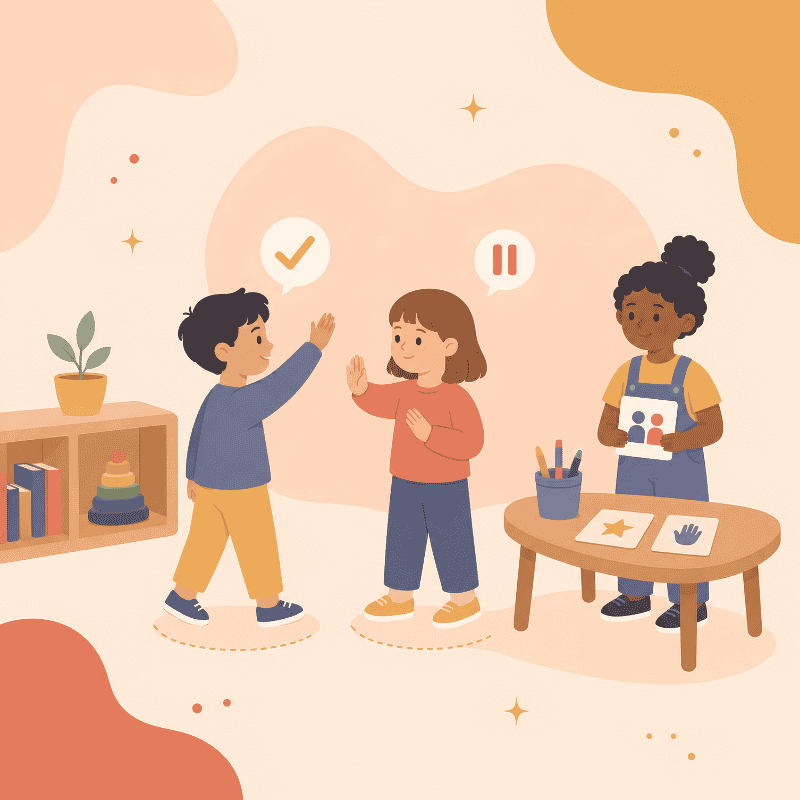
“Would you like a high five?”
“May I sit next to you?”
“Can I join the game?”
“Is it okay if I share this photograph?”

These examples allow pupils to practise consent-related language in a clear, low-pressure context. They also develop the important skill of responding calmly to another person’s answer.
Empty space, drag to resize

A simple consent framework pupils can remember

A short routine gives pupils a clear process to follow when disagreements arise or boundaries change. One suitable KS2 framework is Ask, Listen, Respect and Check Again.

Ask

Ask clearly before borrowing, touching, joining, sharing or changing an activity that affects another person. The question should be specific enough for the other pupil to understand.

Listen

Wait for an answer. Listen to the words and notice signs of discomfort or uncertainty. Silence is not a clear yes.

Respect

Accept the answer without pressure. Pupils should practise responses such as, “Okay, thanks for telling me,” or, “That’s fine, I’ll ask someone else.”

Check again

Permission can change during an activity. If a person says stop, moves away, becomes uncomfortable or no longer wants to take part, stop and check.

Some resources refer to four pillars of consent, often described as freely chosen, informed, specific and changeable. This is not an official DfE primary framework. If schools use it, the ideas should be translated into simple language and kept within age-appropriate Relationships Education.
Empty space, drag to resize

Build safety and ground rules

Ground rules reduce embarrassment and help pupils understand that the lesson is about respectful behaviour, not personal disclosure. Agree them before introducing scenarios.

  • We listen without interrupting or laughing at another person
  • We discuss characters and examples rather than private stories
  • We may pass if we do not want to answer
  • We use clear, respectful language
  • We do not name other pupils when discussing a problem
  • We can ask a question anonymously where the teacher provides this option
  • We understand that adults cannot keep information secret if someone may be unsafe

Teachers should know in advance how they will respond to a worrying question or disclosure. Keeping Children Safe in Education requires staff to act on concerns, follow the school’s child protection policy and report to the designated safeguarding lead or deputy without delay.

Adapting teaching for SEND

Explicit teaching is particularly important for pupils who find social cues, language or flexible situations difficult. Use visuals, repeated scripts, role play with predictable choices and concrete examples. Teach that a clear answer is more reliable than guessing from facial expressions. Some pupils may need support to identify their own discomfort and communicate it through words, symbols, signs or assistive technology.

Keep the core message consistent while adjusting pace, vocabulary and communication method. Pupils should never be excluded from essential safety learning because they need a different way to access it.
Empty space, drag to resize

Practical activities for teaching personal boundaries

Use a personal-space mapping activity

Use floor spots, hoops, diagrams or character cards to explore how different people may prefer different amounts of personal space. Pupils can discuss where a character might stand in a queue, during group work or while talking to a friend. No pupil needs to move towards another child or accept physical contact.

Practise and roleplay for asking and responding

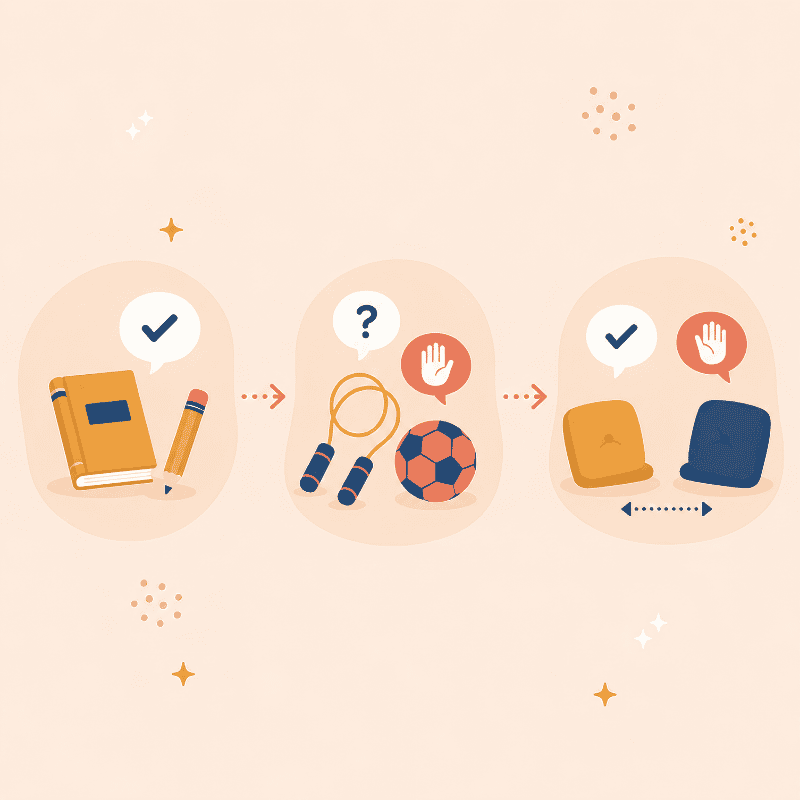
Give pairs low-stakes scripts involving borrowing equipment, joining a game, choosing a partner, sharing a photograph or changing an activity. Rotate the response between yes, no, not now and I have changed my mind. The learning focus is not only asking clearly but accepting and responding to the answer respectfully.

Sort clear and unclear situations

Ask small groups to sort scenario cards into three headings: clear permission, not permitted and stop or check again. Include situations where a pupil initially agrees but later wants to stop. This helps pupils move beyond a simple one-time yes-or-no model.

Include online boundaries

Use examples involving photographs, messages, screenshots, group chats and personal information. Pupils should understand that the same principles of respect and privacy apply online. Asking before sharing a photograph is good relationship practice, although schools must also follow their separate data-protection responsibilities.
Empty space, drag to resize

Connect consent to real school scenarios

consent ks2 scenarios
Consent lessons are most memorable when they reflect situations pupils recognise. Playground games, rough play, lining up, partner work, cloakrooms, shared equipment and online communication all provide useful discussion material.

Questions might include:

  • What should you do if someone wants to leave a game?
  • How can you respond if a friend does not want a hug or high five?
  • When should you ask before borrowing something?
  • What should happen when a joke stops being funny for another person?
  • Is it respectful to keep asking after someone has said no?
  • Why should you check before sharing someone else’s photograph or message?
  • What can you do if another person ignores your boundary?

This broadens KS2 learning about personal boundaries beyond physical contact. It includes privacy, possessions, participation, information, humour and online behaviour.

Avoid presenting consent as a rule that allows pupils to disregard every reasonable instruction from an adult. Teachers and carers sometimes need to act to protect health or safety. Adults should explain what is happening where possible, listen to concerns and never dismiss a child who says that something feels wrong. Pupils should know how to seek help from another trusted adult.
Empty space, drag to resize

Age and stage progression: how consent develops across primary

In England, the statutory Relationships Education guidance sets out what pupils should know by the end of primary school. It requires a graduated, age-appropriate programme but does not prescribe separate outcomes for KS1, lower KS2 or upper KS2. 

Schools therefore need to sequence the learning according to their pupils and curriculum. A practical school-designed progression might look like this:

KS1 foundations

By the end of KS1, pupils should be able to ask before taking or touching, stop when someone says stop, respect personal space, identify trusted adults and recognise basic feelings. Examples should remain immediate and familiar, such as toys, classroom equipment, playtime and sitting on the carpet.

Lower KS2

By the end of lower KS2, pupils should be able to ask clearly before borrowing, joining or sharing, recognise uncertainty, check again, accept a refusal without pressure and identify when adult help is needed. Sorting tasks can help them apply these skills to different personal preferences and changing permission.

Upper KS2

In upper KS2, pupils can explore how permission may change, recognise persistent asking as pressure, apply boundaries to photographs and messages and consider how to support a peer who appears uncomfortable. Learning can also include privacy, group dynamics, online sharing and humour that crosses another person’s boundary.

Progression should add depth rather than repeat the same message each year. By the end of primary school, pupils should have a secure foundation in permission, privacy, personal space, respectful responses, boundaries and help-seeking. This prepares them for more explicit teaching about consent at secondary school.
Empty space, drag to resize

Managing questions, disclosures and safeguarding concerns

Before teaching, staff should be familiar with the school’s child protection policy, know how to contact the DSL or deputy and agree how anonymous questions, disclosures and requests to speak privately will be managed. Ground rules should make clear that pupils are not expected to share personal experiences and that adults cannot promise confidentiality where a child may be at risk.

If a pupil shares something concerning, listen calmly, take it seriously and record the concern using the pupil’s own words where possible. Do not investigate or ask leading questions. Follow the school’s safeguarding procedures and report the concern to the DSL or deputy without delay. Other questions can be answered within the lesson objective or returned to later through the school’s agreed approach.

Teaching about boundaries can help pupils find language for unsafe experiences, but lessons do not replace safeguarding systems. Schools may also find the NSPCC Talk PANTS resources useful as supplementary body-safety material, particularly where content and language are carefully matched to the school’s curriculum.
Empty space, drag to resize

What SLT and PSHE leads should check

A short leadership review should confirm that the curriculum is not relying on one isolated lesson. Leaders should be able to see:

  • Where permission, privacy, personal space, online boundaries and help-seeking are taught across year groups
  • What new knowledge and practical skills each phase adds
  • Whether staff use consistent language across PSHE, behaviour and safeguarding practice
  • How teachers are prepared for questions, disclosures and SEND adaptations
  • How parents can view the intended content and materials, and how governors receive assurance about statutory coverage and safeguarding
  • What evidence, such as planning scrutiny, pupil voice or exit questions, shows that pupils understand and can apply the learning
Empty space, drag to resize

What to do next

consent ks2 next steps
Begin with a curriculum audit. Identify where pupils learn about permission-seeking and giving, privacy, personal space, appropriate and inappropriate contact, online boundaries and help-seeking. Check that each year group builds on prior learning and that staff use consistent language across Relationships Education, PSHE, behaviour and safeguarding.

Then review lesson readiness. Staff should understand the ground rules, likely questions, adaptations for pupils with SEND and the school’s safeguarding procedures before teaching. Parents and carers should receive clear information about the learning objectives, examples and resources, with the primary focus on respectful relationships, personal boundaries and safety.

Leaders should also check that this learning connects with the school’s wider work on positive relationships in primary schools, sex and relationships education and safeguarding in schools rather than sitting within one isolated lesson.

Muse Wellbeing includes progressive lessons on respectful relationships, personal boundaries, online safety and help-seeking across Years 1 to 6. Explore the KS2 PSHE curriculum or review the complete Muse Wellbeing PSHE and RSE Scheme of Work to see how these themes develop throughout primary school.
Empty space, drag to resize

Frequently Asked Questions

What does consent mean in KS2?

In KS2, consent can be explained as asking before an action involves another person, waiting for a clear answer and respecting that answer. In England’s statutory Relationships Education, these foundations are taught through permission-seeking and giving, privacy, personal space, appropriate boundaries and understanding the difference between appropriate and unsafe contact.

Is teaching consent in primary school age-appropriate?

Yes. In primary school, consent should be taught through everyday, age-appropriate situations involving permission, personal space, belongings, play, online sharing, respectful boundaries and help-seeking. Detailed teaching about sexual consent belongs within secondary RSE.

Is consent statutory in primary school?

Yes, primary schools in England must teach the statutory foundations of consent through Relationships Education. These include permission-seeking and giving, privacy, personal space, boundaries, understanding that each person’s body belongs to them, recognising inappropriate or unsafe contact and knowing how to seek help. The guidance describes these as the forerunners of consent teaching, with more explicit teaching about consent taking place at secondary school.

How is consent linked to PSHE and Relationships Education?

Relationships Education is compulsory in primary schools. The relevant statutory content sits within caring friendships, respectful relationships, online relationships and being safe. Many schools deliver these outcomes through their wider PSHE curriculum and reinforce them through behaviour, online safety and safeguarding practice.

What are good examples of consent for KS2 pupils?

Useful examples include asking before borrowing an item, joining a game, sitting close to someone, giving a high five, sharing a photograph or changing the rules of an activity. Pupils should also practise accepting a refusal calmly and stopping when permission changes.

How can consent teaching be adapted for pupils with SEND?

Use explicit language, visual supports, repetition, predictable scripts and each pupil’s established communication method. Break complex situations into smaller steps and do not expect pupils to infer permission from subtle social cues. Adapt access to the learning without reducing the core expectations around boundaries, safety and help-seeking.

Should consent only be taught in upper KS2?

No. The statutory guidance expects a graduated, age-appropriate programme, and the foundations begin from the start of primary school through taking turns, asking permission, respecting personal space and knowing when to seek help. Lower and upper KS2 can add changing permission, privacy, peer pressure, online boundaries and more complex friendship situations.

How should schools involve parents and carers?

From 1 September 2026, schools should tell parents what will be taught, when and which resources will be used. They must publish an up-to-date Relationships Education policy and consult parents on it. Parents cannot withdraw children from Relationships Education, Health Education or science, but may request withdrawal from primary sex education taught beyond the science curriculum.

What are the four pillars of consent?

The “four pillars” are not an official DfE primary framework. Some resources use the phrase to describe consent as freely chosen, informed, specific and changeable. Primary schools using these ideas should translate them into simple, age-appropriate examples involving permission, personal space, belongings, play and changing one’s mind.
Empty space, drag to resize

Key takeaways

  • In primary schools, teach the foundations of consent through permission, privacy, personal space, boundaries and help-seeking.
  • The revised RSHE guidance describes these as forerunners of explicit consent education at secondary level.
  • Use clear words and teach pupils that silence or uncertainty is a reason to stop and check.
  • Practise both asking and accepting another person’s refusal respectfully.
  • Cover belongings, play, humour, privacy and online sharing as well as physical contact.
  • Use fictional scenarios and safe ground rules rather than asking pupils to disclose personal experiences.
  • Build progression across primary and prepare staff to respond to safeguarding concerns
Empty space, drag to resize

Conclusion

Teaching consent in KS2 is most effective when schools are precise about what primary pupils need. The statutory foundations are not complicated adult concepts. They are the practical habits of asking, listening, respecting personal space, protecting privacy, responding when permission changes and seeking help when something feels wrong.

The revised guidance positions primary Relationships Education as the foundation for later consent education. A coherent sequence across KS1 and KS2 is stronger than a single lesson in Year 6.

The Muse Wellbeing platform brings these themes together within a progressive PSHE and RSE curriculum for Years 1 to 6, with teacher guidance, lesson slides and supporting resources designed for practical classroom use.
Created with