PSHE Resources for Primary Schools

Authored by the Muse Wellbeing Team

First Published on the 26th of March, 2026.

Lead Writer

David is a qualfied British teacher and the Muse Wellbeing director and lead curriculum developer. His main passions include education, surfing (badly) and travel.

Editor and Review

With over 15 years of experience teaching in primary schools in northern England, Charlotte has played a key role in shaping many lessons across the Muse Wellbeing curriculum.
Many primary school teachers would agree that finding high-quality PSHE resources is more time consuming than it probably should be. There are many free online resources available; however, finding quality resources that are age-appropriate, sequential and statutorily compliant is not the same story.

The purpose of this article is to provide better guidance for primary teachers and PSHE subject leads on what good quality PSHE resources for both KS1 and KS2 should look like, where to search for free resources and how to save planning time each half term.

What Should PSHE Resources Cover?

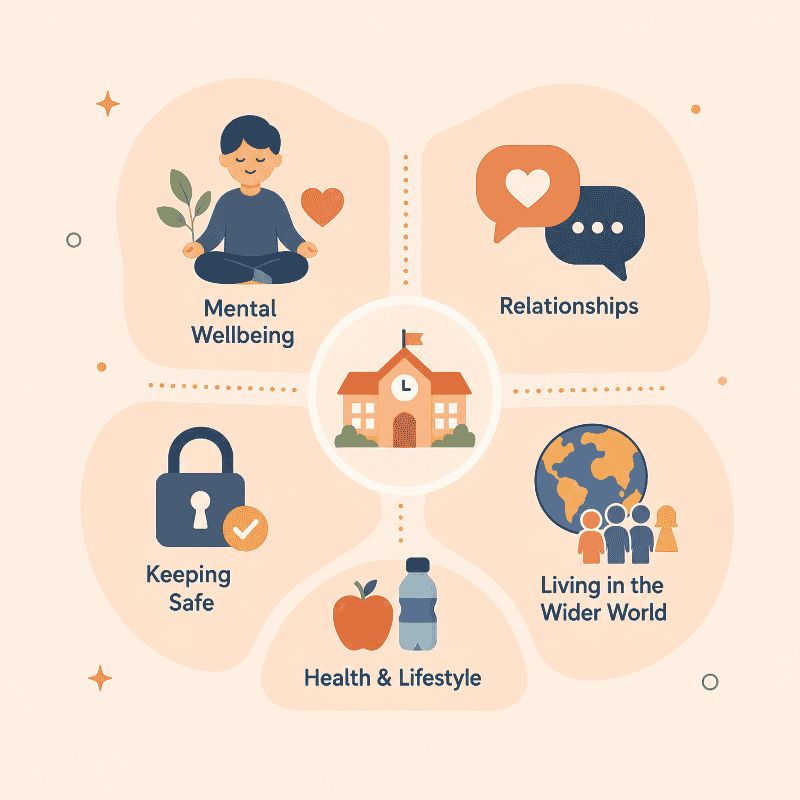
High quality PSHE resources should reflect the three core areas central to the subject: understanding health and wellbeing, understanding relationships and understanding the world around us. All these areas are directly mapped from the statutory guidance for Relationships Education and Health Education which applies to all primary schools.
In most cases, resources that focus on just one area in isolation leave gaps. A well-structured PSHE curriculum needs to progressively and sequentially address all three strands as children move through the school. If your current resources lack coherence, it may be worth considering whether they are actually providing value to your pupils.

A full breakdown of the specific topics that schools need to cover can be found in our PSHE topics guide.

PSHE Resources for KS1

At KS1, resources need to be concrete, accessible and grounded in children’s everyday experience. Younger children have developing emotional vocabularies, so abstract ideas work best when introduced using stories, visual prompts and class discussion rather than written tasks.

Effective KS1 PSHE resources typically explore themes such as friendships, feelings, keeping safe and basic health habits. The approach used is just as important as the content itself. A well-chosen question with a structured discussion will usually do more than a busy activity pack.

Resources at this stage also need to be easy enough for class teachers to pick up and deliver confidently. Having clear guidance is helpful, but effective materials must leave room for the kind of open conversation that makes PSHE genuinely meaningful for young children.

PSHE Resources for KS2

KS2 is where PSHE really begins to expand in scope. Topics such as mental health, puberty, online safety, healthy relationships and economic wellbeing become increasingly important as children move through Years 3 to 6.

Teaching resources for KS2 need to reflect that growing complexity. Body image, peer pressure and substance awareness require thoughtful handling, and the materials behind them need to be developed with clearly defined developmental stages in mind. Resources that are too vague miss the point, while those poorly calibrated to the age group can do more harm than good.

The PSHE Association provides quality standards for PSHE education resources that are worth checking before committing to any programme or materials for your school.

Are There Free PSHE Resources for Primary Schools?

Yes, and some of them are genuinely useful. Oak National Academy has created free, structured lesson plans for KS1 and KS2 that are well-organised and straightforward to follow. The NHS also provides excellent information about physical development, mental health and healthy lifestyle choices, which can be used to supplement PSHE lessons across year groups.
Although free PSHE resource packs for primary schools will not normally give you everything required, a single lesson plan or activity sheet may be sufficient to support your existing resources. However, you will need a more extensive range of materials to provide continuity of learning across a full PSHE curriculum.

Also, Muse Wellbeing currently offers the entire PSHE curriculum free of charge until September 2028. This gives you 216 fully planned PSHE lessons across Years 1 through to Year 6, each designed according to statutory RSHE guidelines. Because the planning has already been done, teachers can focus entirely on delivery.

PSHE Resources for SEND Pupils

When selecting PSHE resources for inclusion purposes, it is essential that the activities allow pupils with SEND to take part alongside their peers. Some of the most difficult aspects of certain PSHE resources are the reading and writing requirements, which can place pupils with SEND at a significant disadvantage.

Differentiation should ideally be incorporated into the original design rather than added on afterwards. When selecting PSHE resources, look for ones that offer visual aids, simplified language options and activities that are accessible to pupils who need additional challenge. By incorporating differentiation from the start, PSHE lessons tend to run more smoothly for every pupil in the classroom.

Each lesson within the Muse Wellbeing curriculum includes differentiated tasks and supporting materials to help all pupils engage and make progress regardless of their starting point.

Final Thoughts

PSHE resources for primary schools come in many forms, but quality and coherence are what separate the useful from the merely adequate. Whether you are building a topic unit from scratch or looking for a full scheme that works across the whole school, the starting point is always the same: resources need to be age-appropriate, properly sequenced and grounded in statutory guidance.

Muse Wellbeing provides a complete primary PSHE and RSE curriculum with 216 lessons spanning Year 1 to Year 6. Schools can access the full curriculum free of charge until September 2028. If you are looking for a structured, ready-to-use approach, explore the Muse Wellbeing curriculum to see how it works in practice.
Created with