PSHE Statutory Guidance hero

PSHE Statutory Guidance for Primary Schools: What Changes in September 2026

Authored by the Muse Wellbeing Team

First Published on the 31st of July, 2026.

Lead Writer

David is a qualified British teacher and the Muse Wellbeing director and lead curriculum developer. His main passions include education, surfing (badly) and travel.

Editorial Review

With over 15 years of experience teaching in primary schools in northern England, Charlotte has played a key role in shaping many lessons across the Muse Wellbeing curriculum.
PSHE statutory guidance is the phrase many schools use for the legal requirements within a wider Personal, Social, Health and Economic education programme. The official Department for Education document is the Relationships Education, Relationships and Sex Education and Health Education statutory guidance, usually shortened to RSHE guidance.

The revised guidance was published in July 2025 and comes into force on 1 September 2026. Until 31 August 2026, schools should continue to have regard to the 2019 guidance while preparing their curriculum, policy and resources for the new requirements. Primary leaders should use this transition period to identify changes and complete the necessary checks before the new academic year.

Most schools will not need to replace their whole PSHE curriculum. They will need to check that statutory content is complete, carefully sequenced and clearly explained to staff, governors and parents. They should also make sure that policies and teaching materials reflect the more detailed expectations around safeguarding, online life, health, parent transparency and pupil needs.

This guide applies to schools in England. International schools and schools elsewhere in the UK may find the curriculum principles useful, but they should follow the requirements that apply in their own location.

Contents

Empty space, drag to resize

What PSHE statutory guidance means in 2026

PSHE is not a standalone statutory subject for maintained primary schools or academies. However, significant parts of a typical PSHE programme are statutory. Relationships Education is compulsory for all pupils receiving primary education. Health Education is compulsory in state-funded schools, while independent schools have separate requirements to provide PSHE under the Independent School Standards.

From 1 September 2026, schools must have regard to the revised RSHE statutory guidance. This means they are expected to follow the guidance and need good reasons if they depart from sections that say they should or should not do something.

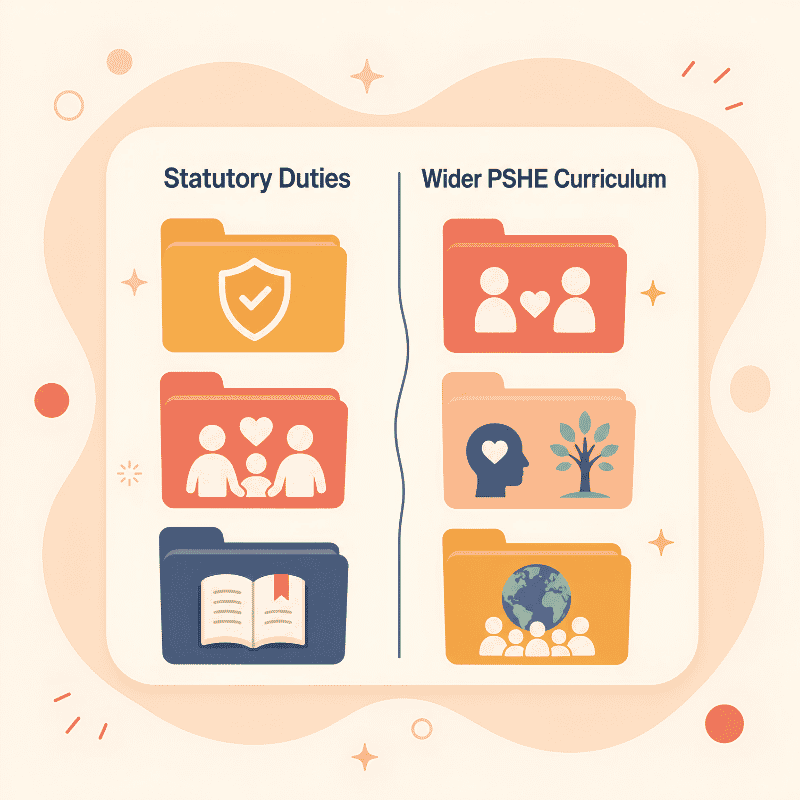
A useful curriculum review separates three areas clearly: the statutory Relationships Education and Health Education content that must be covered; additional sex education that a primary school chooses to teach beyond Relationships Education, Health Education and the science curriculum; and the wider PSHE offer, including areas such as economic wellbeing, citizenship, careers and community participation.

These areas can be taught through one coherent PSHE programme, but leaders and teachers should be able to identify which learning meets statutory requirements. This distinction matters for curriculum mapping, policy wording, parent communication and withdrawal requests.

The guidance also connects with safeguarding, equality duties, the science curriculum and the Early Years Foundation Stage. Reception provision will often establish foundations through personal, social and emotional development, communication, routines, relationships and safe behaviour rather than through a discrete PSHE lesson. A clear PSHE EYFS to Year 6 sequence helps schools show how early learning develops into the statutory knowledge and skills expected by the end of primary school.
Empty space, drag to resize

What the 2025 RSHE guidance changes for primary schools

The revised guidance is more than a minor wording update. It retains the core statutory model introduced in 2020, but adds greater detail about curriculum principles, parent transparency, safeguarding, online life, health and the knowledge pupils should develop by the end of primary school.

Schools should read the full revised RSHE statutory guidance rather than relying only on summaries, then compare its primary curriculum tables and policy requirements with their current provision.

Clearer policy requirements and parent transparency

All schools must have an up-to-date written policy for Relationships Education or, where primary sex education is taught, for RSE. The policy must be available free of charge and published on the school website. Schools must also engage and consult parents when developing or reviewing it.

The revised guidance is more specific about what the policy should explain. This includes what will be taught, how and when it will be taught, who is responsible for delivery, how pupils with SEND will access the curriculum, how the subject will be monitored and how parents can view teaching materials. It should also distinguish Relationships Education from any additional sex education so that withdrawal rights are clear.

Schools should proactively tell parents what is being taught and should show a representative sample of resources. Schools should ensure that parents can view all RSHE curriculum materials on request. Copyright may affect how resources are shared, but it should not be used as a reason to refuse access. The Muse Parent, Policy And School Engagement guidance can support schools when reviewing how curriculum information is communicated.

Stronger principles for sequence and delivery

The revised guidance introduces a clearer set of curriculum principles. Schools should meaningfully engage pupils, communicate openly with parents, build positive attitudes and skills, sequence learning carefully and make teaching relevant to the age, stage and needs of pupils. Delivery should be participative, safe and supported by staff who have the knowledge and confidence to manage sensitive discussion and possible disclosures.

The revised curriculum principles give greater weight to progression. Repeating a broad theme such as friendship, safety or wellbeing each year is not enough on its own. The knowledge, vocabulary, scenarios and decisions pupils explore should become more developed as they move through school. A PSHE progression map should show how learning builds and where statutory outcomes are introduced, revisited and deepened.

More detailed relationships and safeguarding content

The relationships content remains focused on families, friendships, respect, online relationships and being safe. However, the revised guidance gives schools more detail about the skills and knowledge pupils should develop.

  • Understanding loneliness and knowing that it is normal to seek support
  • Managing conflict without violence and repairing friendships where possible
  • Communicating needs and boundaries assertively without becoming controlling
  • Understanding self-respect, self-esteem and a positive sense of identity
  • Recognising stereotypes, bullying and harmful or dangerous relationships
  • Knowing how to report abuse or concerns and continuing to ask for help until they are heard

This content should link naturally with the school’s safeguarding procedures. Pupils need age-appropriate language for boundaries, privacy, body ownership, unsafe contact and trusted adults. Teaching should help children recognise risk without suggesting that abuse is ever their fault.

A broader approach to online life and financial harms

Online safety is treated as part of relationships, wellbeing and personal safety rather than as a separate annual lesson. Primary pupils should learn about respectful online behaviour, pressure to share information or images, privacy and location settings, harmful contact and how online information is selected or targeted.

The revised primary content also refers to age restrictions, gaming, video game monetisation, scams, fraud and other financial harms. Schools should therefore check that online safety lessons reflect the digital experiences children are likely to encounter now, including in-app spending, the risk that gaming can become addictive and content that may be upsetting or inappropriate.

At Muse Wellbeing, Digital Citizenship is a key element of learning. It brings together online safety, respectful communication, privacy, responsible technology use and healthy digital habits so that pupils develop the knowledge and confidence to make safer choices both online and offline. 

Expanded health, wellbeing and personal safety content

The revised Health Education content continues to cover physical activity, healthy eating, mental wellbeing, sleep, hygiene, first aid, puberty and health protection. It also adds or strengthens several areas that may require curriculum updates.

  • Grief, bereavement, isolation and seeking early support for mental health difficulties
  • A healthy relationship with food alongside knowledge about nutrition
  • Smoking, vaping, nicotine addiction and products such as nicotine pouches
  • The amount and quality of sleep children need and practical steps such as keeping screens out of the bedroom
  • Vaccination and immunisation taught in line with when vaccinations are offered
  • Personal safety around fire, roads, railways and water
  • Basic first aid, including head injuries and making an efficient emergency call rather than filming an incident
  • Correct names for body parts, personal boundaries and the menstrual cycle before pupils are likely to experience periods

Schools do not need to turn each line of guidance into an isolated lesson. They do need to ensure the full content is taught in a way that is age appropriate, accessible and connected to pupils’ lives.

Primary sex education and withdrawal rights

Sex education remains non-compulsory in primary schools. The revised guidance recommends that primary schools teach sex education in Years 5 and/or 6, in line with content about conception and birth in the national curriculum for science. Schools should consult parents about the content of anything taught within sex education, offer support for discussing it at home and explain the right to request withdrawal.

Parents have the right to request withdrawal from some or all additional sex education taught outside the science curriculum. The headteacher should discuss the request with parents, but in a primary school must grant it. There is no right to withdraw from Relationships Education, Health Education or topics taught through the science curriculum, including science content related to puberty or sexual reproduction. The school should provide appropriate, purposeful education during the period of withdrawal and make the process clear in its policy and parent information.

Equality, families and contested issues

The guidance continues to require schools to meet the Equality Act 2010 and to teach in a way that does not discriminate against or harass pupils. Teaching should illustrate a wide range of family structures positively, including families with same-sex parents, while ensuring that children are not stigmatised because of their home circumstances.

The revised guidance states that pupils should understand the importance of equality and respect and learn about the law relating to all protected characteristics by the end of secondary education. It also says that pupils should be taught the facts and law about biological sex and gender reassignment. Beyond those facts and the law, schools should not endorse a particular view or present debated ideas as established fact. In primary schools, relevant teaching should remain factual, age appropriate, respectful and consistent with equality and safeguarding duties, without reinforcing stereotypes or permitting bullying.

Policy, governors and parent partnership

Governors and trustees do not need to review every lesson, but they should assure themselves that pupils are making progress, teaching is accessible to pupils with SEND, curriculum content and materials align with the guidance and parents receive clear information about content, materials, external providers and withdrawal rights. A concise annual update can cover statutory mapping, curriculum changes, staff training, parent engagement and any local safeguarding priorities.

Parent communication works best when it is proactive, regular and calm. A yearly overview, a representative sample of resources, a clear process for viewing all materials on request and early notice of sensitive content are more useful than a single letter shortly before puberty or sex education lessons. Schools should explain what is statutory, what the school has chosen to add, when it will be taught and how questions will be handled safely.
Empty space, drag to resize

What the PSHE and RSHE changes mean for September 2026

PSHE Statutory Guidance 2026
There is a clear legal timeline. The 2019 statutory guidance remains the version for teaching until 31 August 2026. The revised guidance published in July 2025 applies from 1 September 2026. This is not an optional preparation window or a general direction of travel. Schools should be ready to deliver the revised requirements from the start of the 2026 to 2027 academic year.

An accurate audit is the most useful first step. Once leaders know what is already secure, what has changed and where gaps remain, the work becomes easier to plan, prioritise and delegate.

What to prioritise before September 2026

Before September 2026, schools should map every revised primary Relationships Education and Health Education outcome against the current curriculum. They should identify new or strengthened content, especially online life, financial harms, personal safety, vaping, sleep, bereavement, body vocabulary and parent transparency.

Next, update the Relationships Education or RSE policy and complete appropriate parent consultation. Check that parents can view curriculum materials and understand withdrawal rights. Review staff confidence and provide focused support for changed content. Finally, confirm that resources are accurate, age appropriate, accessible for pupils with SEND and aligned with safeguarding procedures.

What can continue after the new guidance starts

A curriculum can be compliant in September while still improving through the year. Deeper refinements to assessment, pupil voice, cross-curricular links and staff development can continue through normal monitoring cycles. The priority is that statutory content, policy and essential resources are ready and that teachers know what they are expected to deliver.

What schools now need to review

A practical review should focus on the parts of provision that affect pupils and staff rather than producing documents for their own sake.

1. Recheck statutory coverage
Map every primary outcome in the revised guidance to a year group, lesson or planned learning opportunity. Where an outcome is covered across several lessons, make that progression visible.

2. Update policy language
Use Relationships Education, Health Education, RSE and PSHE accurately. State what is compulsory, what the school chooses to teach and what parents can request withdrawal from.

3. Review progression
Check that learning becomes more complex over time. Pupils should encounter increasingly developed vocabulary, scenarios, decision-making and opportunities to practise skills.

4. Audit staff confidence
Ask teachers which topics they feel ready to teach and where they need clearer planning, model language or safeguarding guidance. Training should respond to genuine needs rather than repeat familiar content.

5. Check resources and external providers
Schools remain responsible for all content, including materials provided by external organisations. Review accuracy, age and stage appropriateness, accessibility, whether materials are unbiased and the safeguarding processes that will apply before use.

6. Revisit parent-facing information
Update website summaries, policy documents, yearly overviews and resource-viewing arrangements. Clear information reduces confusion and supports constructive parent partnership.

7. Confirm governor oversight
Provide governors or trustees with enough information to understand coverage, implementation, SEND access and parent transparency without drawing them into lesson-level management.
Empty space, drag to resize

How curriculum planning is affected

Schools do not automatically need a brand-new scheme. The more useful question is whether the current structure covers the revised outcomes, sequences them coherently and gives teachers enough support to deliver them well.

Map broad themes to specific outcomes

Broad themes remain useful, but each one should connect to specific outcomes. A unit called ‘Staying Safe’ might cover body boundaries, trusted adults, roads, water, online concerns and emergency help across different year groups. The long-term plan should show where each part is introduced and how it develops.

Show progression from Reception to Year 6

Reception, KS1, lower KS2 and upper KS2 should form one learning journey. Early teaching may focus on naming feelings, identifying trusted adults, taking turns and following simple safety rules. Later teaching can develop boundaries, peer pressure, online decisions, puberty, conflict and help-seeking. The PSHE Education Foundations approach can help schools review the broad structure before refining individual lessons.

Plan sensitive learning content in advance

Sensitive content should be planned with care. Staff benefit from agreed vocabulary, clear ground rules, anonymous question systems where appropriate and reminders about how to respond to disclosures. Resources should support calm and factual teaching without exposing pupils to unnecessary detail or alarm.

Useful evidence for leaders and governors

A long-term plan, statutory mapping document, progression overview, policy, parent materials and a short record of relevant staff support will usually provide a clear evidence trail. The purpose is to help the school understand and improve its provision, not to create an inspection folder that staff never use.
Empty space, drag to resize

What Ofsted looks for in PSHE and RSHE without creating paperwork

PSHE Statutory Guidance ofsted
As of July 2026, Ofsted’s current state-funded schools inspection toolkit remains in use for inspections before 7 September 2026. The updated toolkit applies from 7 September 2026. Under both versions, PSHE and RSHE are considered mainly through personal development and wellbeing, safeguarding, inclusion, curriculum and teaching and leadership and governance. The September toolkit is especially clear that the expected standard includes a suitable and well-taught Relationships and Health Education (RHE) or RSHE programme that develops pupils’ knowledge.

Ofsted does not expect leaders to create documents or presentations for inspection, use a particular planning format or produce individual lesson plans. Inspectors use statutory documents and information the school already produces, alongside first-hand evidence from professional conversations, learning walks, discussions with pupils and staff and pupils’ work where appropriate. Information simply needs to be current and easy to access.

What inspectors may explore

A PSHE lead should be ready to explain the school’s overall programme: what pupils learn, how knowledge builds from Reception to Year 6, where statutory content is covered and how leaders know teaching is making a difference. Inspectors may consider whether staff have the knowledge and confidence to teach the programme and whether pupils develop age-appropriate knowledge about healthy relationships, safety and seeking help. They may also look at whether the curriculum responds to the school’s context, whether pupils with SEND or other barriers can access and benefit from it and whether leaders’ explanations match what pupils, staff, planning and classroom practice show.

What reasonable evidence can look like

Useful evidence is the material the school already uses: a long-term curriculum map, progression overview, statutory mapping, current policy, representative planning and resources, parent information and records of relevant staff training or curriculum monitoring. Normal assessment information or pupil voice may also help leaders evaluate impact, but Ofsted does not require a special PSHE evidence file or a set quantity of work in pupils’ books. Leaders should understand any adaptations made to a purchased scheme and why.

Inspection-week risks to avoid

The most significant risks are not missing folders. They are gaps in statutory coverage, a programme that is not coherent or well taught, policies that do not match practice, pupils who do not gain or retain the intended knowledge, weak access for pupils with SEND or others facing barriers and staff uncertainty about safeguarding or sensitive content. The September 2026 toolkit states that personal development and wellbeing may be graded ‘urgent improvement’ where the curriculum fails to teach healthy relationships in line with statutory guidance. Routine curriculum review, staff support and sensible monitoring are therefore more useful than inspection-week paperwork.
Empty space, drag to resize

Essential points for primary schools

PSHE is broader than the statutory subjects
The wider PSHE label includes non-statutory content. Relationships Education is compulsory in all primary schools, while Health Education is compulsory in state-funded schools. A coherent whole-school plan is the simplest way to sequence and quality assure this learning.

A scheme does not make a school automatically compliant
A scheme is a resource, not a transfer of responsibility. Leaders should check coverage, progression, safeguarding, local relevance, parent transparency and accessibility for pupils with SEND.

Withdrawal rights apply only to additional sex education
Parents cannot withdraw pupils from Relationships Education, Health Education or statutory science. They can request withdrawal from primary sex education taught outside the science curriculum, and the headteacher must grant that request.

Progression is more than repeating the same topic
Revisiting themes is helpful, but progression requires development. Vocabulary, knowledge, scenarios and expected pupil responses should become more sophisticated as children grow.

Glossary of key terms

PSHE means Personal, Social, Health and Economic education and is commonly used as the umbrella for a wider personal development curriculum.

Relationships Education is the compulsory primary subject covering families, friendships, respectful relationships, online relationships and being safe.

Health Education is compulsory in state-funded schools and covers physical health, mental wellbeing, personal safety, first aid, puberty and related knowledge.

RSE means Relationships and Sex Education. It is compulsory in secondary schools. Primary schools must teach Relationships Education and may choose to teach additional sex education.

RSHE is the collective term for Relationships Education, RSE and Health Education.

A progression map shows how knowledge and skills build across year groups.
Empty space, drag to resize

A practical school response for 2026 and beyond

Use the revised guidance and its primary curriculum tables to audit current provision. Map lessons and resources against each statutory outcome, identify secure coverage and genuine gaps, then update the long-term plan and PSHE progression map where sequencing needs to change.

Review the Relationships Education or RSE policy so it reflects the curriculum being taught, and engage and consult parents when it is developed or revised. Keep parent information and resource-viewing arrangements clear, give staff focused support for sensitive or updated content and build regular review points into the annual curriculum cycle.

Muse Wellbeing provides a structured, progressive primary PSHE and RSE curriculum with 216 planned lessons from Year 1 to Year 6. The programme is aligned with the revised 2025 RSHE guidance and includes curriculum maps, teacher guidance, lesson plans, presentation slides and differentiated resources to support consistent delivery across the school.

Schools can explore the Muse Wellbeing PSHE and RSE Scheme of Work or view the complete curriculum to see how statutory coverage, progression and classroom resources connect in practice.
Empty space, drag to resize

Frequently Asked Questions

Is PSHE statutory in primary schools?

PSHE as a broad subject is not a standalone statutory subject for maintained primary schools or academies. Relationships Education is compulsory for all primary pupils and Health Education is compulsory in state-funded schools. Many schools teach both through a wider PSHE programme.

What is new in the 2025 PSHE statutory guidance?

The revised RSHE guidance adds clearer curriculum principles, stronger parent transparency and more detailed primary content. Important areas include online relationships, gaming and financial harms, vaping, sleep, personal safety, first aid, body vocabulary, bereavement and careful progression.

When does the revised guidance become compulsory?

The revised guidance applies from 1 September 2026. The 2019 guidance remains the version for teaching until 31 August 2026.

Do schools need to rewrite their PSHE or RSE policy?

Schools must have an up-to-date written Relationships Education or RSE policy. A full rewrite may not be necessary, but the policy should be checked against the revised requirements, including parent consultation, access to materials, SEND accessibility, monitoring and withdrawal information.

How should primary schools evidence compliance?

Schools should be able to show where statutory outcomes are taught and how learning builds. Useful evidence includes a curriculum map, statutory mapping, progression overview, policy, parent information and normal planning or assessment records. Ofsted does not require a special inspection folder.

Does the guidance affect EYFS?

The RSHE statutory subjects apply to pupils receiving primary education, while Reception also sits within the EYFS framework. Early years teaching provides important foundations through personal, social and emotional development, safe routines, relationships, feelings and trusted adults.

Can parents withdraw a child from Relationships Education?

No. Parents cannot withdraw a child from Relationships Education, Health Education or statutory science. They can request withdrawal from additional primary sex education taught outside the science curriculum.

Is sex education compulsory in primary schools?

No. The revised guidance recommends that primary schools teach sex education in Years 5 and/or 6, but it is not compulsory. Schools should consult parents about the content and explain which learning sits within science and which is additional sex education.

What should teachers do if they feel unsure about sensitive topics?

Teachers should not be expected to improvise. Leaders should provide clear planning, agreed vocabulary, model responses, safeguarding reminders and time to discuss questions before teaching begins.
Empty space, drag to resize

Key takeaways

  • The revised RSHE guidance published in July 2025 applies from 1 September 2026.
  • PSHE is broader than the statutory subjects, but Relationships Education and Health Education must be clearly mapped.
  • Primary schools should review new and strengthened content, especially online life, safety, health and parent transparency.
  • Policies must be up to date, published and developed through parent engagement and consultation.
  • Parents can view RSHE materials and may request withdrawal only from additional primary sex education, not Relationships Education, Health Education or statutory science.
  • Ofsted expects clear, effective provision but does not require documents created specifically for inspection.
Empty space, drag to resize

Conclusion

The revised 2025 guidance does not require primary schools to discard good existing practice. It asks schools to update it for the realities children now face and to be clearer about sequence, safeguarding, resources and communication. The immediate task is to identify the difference between the current curriculum and the requirements that apply from September 2026.

A focused audit, an accurate policy and well-supported staff will address the main implementation priorities. Once those foundations are secure, leaders can continue refining assessment, pupil voice and wider PSHE provision through the normal curriculum cycle.

Muse Wellbeing provides a structured, progressive primary PSHE curriculum that brings together statutory Relationships Education and Health Education with wider PSHE content. Schools can view the programme, review sample resources and explore the curriculum structure to support planning from Year 1 to Year 6.
Created with