pshce vs pshe hero

PSHCE vs PSHE vs RSHE: A Clear Guide for Schools

Authored by the Muse Wellbeing Team

First Published on the 31st of July, 2026.

Lead Writer

David is a qualified British teacher and the Muse Wellbeing director and lead curriculum developer. His main passions include education, surfing (badly) and travel.

Editorial Review

With over 15 years of experience teaching in primary schools in northern England, Charlotte has played a key role in shaping many lessons across the Muse Wellbeing curriculum.
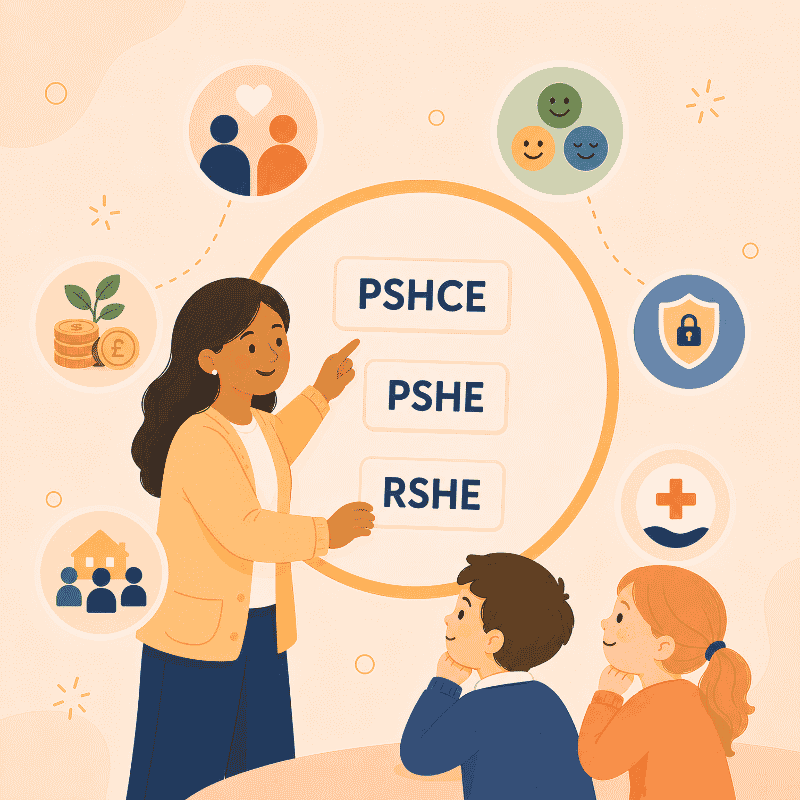
School acronyms can cause unnecessary confusion when staff are planning lessons, updating policies, responding to parents and checking that provision reflects statutory expectations. PSHCE, PSHE, RSHE and RSE are often used interchangeably, alongside non-standard variations and misspellings such as PHSE and PSCHE, but the terms do not all mean the same thing. 

For primary schools, the most practical approach is usually to use PSHE for the wider curriculum, RSHE when discussing statutory relationships, sex and health education requirements and PSHCE only where the school defines it clearly. For a broader introduction to the subject, see the meaning of PSHE.

Contents

Empty space, drag to resize

What each acronym means

The three terms are closely related, but each has a distinct purpose.

PSHE stands for Personal, Social, Health and Economic education. In maintained schools and academies, PSHE is a non-statutory subject, although the Department for Education says all schools should teach it. Independent schools have separate requirements to provide PSHE. In everyday school use, PSHE remains the broadest umbrella term, covering relationships, health, safety, feelings, identity, money, citizenship and preparation for life beyond the classroom.

RSHE is commonly used as shorthand for Relationships, Sex and Health Education. It collectively describes the statutory relationships, sex and health education requirements rather than the formal title of a single primary subject. In primary schools, the compulsory subjects are Relationships Education and Health Education. Sex education beyond the national curriculum for science is not compulsory, although schools may choose to teach it.

PSHCE most commonly stands for Personal, Social, Health and Citizenship Education. Some schools also include Economic in the expansion. It is a less common, non-standardised variation of PSHE used to make citizenship explicit, so any school using PSHCE should define it in its policy and curriculum documents. PHSE is usually a spelling error or mishearing of PSHE, while PSCHE may appear as a local variation but is not standard Department for Education terminology.

Terminology shapes curriculum documents, policies, governor reporting and parent communication. It also helps staff distinguish the school’s wider personal development offer from the statutory content it must teach. For further guidance on statutory requirements, see whether PSHE is compulsory.
Empty space, drag to resize

PSHCE vs PSHE vs RSHE: Quick comparison

Term What it stands for Best used for Key feature Planning consideration Typical status in school documents
PSHCE Usually Personal, Social, Health and Citizenship Education Explaining older terminology or legacy curriculum language Highlights citizenship explicitly May need explanation because it is not standard DfE terminology Older term or local variation
PSHE Personal, Social, Health and Economic education Whole-school curriculum planning and general subject naming Widely recognised umbrella term Can be too broad if statutory duties are not distinguished explicitly Most common school-facing label
RSHE Relationships, Sex and Health Education Statutory guidance, policy language and parent communication Tied closely to legal curriculum duties Can imply a narrower scope than your full PSHE offer Used for statutory framework discussions

Empty space, drag to resize

PSHCE

PSHCE usually appears in older planning documents, local authority templates or schools that want citizenship named explicitly. Because it is not standard Department for Education terminology, schools should define what the acronym means wherever they use it. The label may also remain in place after wider curriculum language has changed.

One strength of PSHCE is that it makes citizenship explicit, signalling that rights, responsibilities, belonging, democracy and social participation sit alongside health and relationships. However, primary schools do not usually need a separate acronym to justify this coverage. Citizenship can still be mapped securely within a modern PSHE curriculum.

A planning risk is limited recognition. Because PSHCE is not standard Department for Education terminology, schools may need to explain it to new staff, parents, governors and pupils. If the policy uses PSHCE, the website uses RSHE and subject leadership documents use PSHE, the curriculum can be harder to explain clearly during an inspection or parent consultation.

PSHCE may remain appropriate as a local label where a school has a well-understood rationale and applies it consistently. For most primary settings, however, it is better treated as a recognised legacy term rather than the principal label for the subject.
Empty space, drag to resize

PSHE

pshce vs pshe 3
PSHE is the term most primary schools use as an umbrella for personal development learning. It can encompass emotional literacy, friendships, physical health, safety, money, identity, community and aspects of citizenship. This breadth gives schools a practical subject heading for schemes of work, progression maps, lesson timetables and professional discussion.

PSHE is particularly useful when describing the full breadth of pupils’ learning, not only the content required by law. Many schools teach beyond the statutory minimum because pupils’ needs do not always fit neatly within individual curriculum categories. Online behaviour, difficulties in friendships, worry, belonging, body privacy, transitions and decision-making may need to be addressed within the same sequence of learning.

The risk lies not in the term itself, but in how broadly it is sometimes applied. If all provision is labelled PSHE, schools may blur the distinction between statutory requirements and additional curriculum content. For example, if all lessons are simply labelled PSHE, staff may struggle to identify where compulsory Relationships Education and Health Education content is taught. This can create difficulties when reviewing policy, consulting parents or checking what must be taught in each year group.

Used well, PSHE is the most useful everyday label for a school’s broader curriculum. It works best when supported by precise documentation showing where statutory RSHE content sits within that offer. For further context on curriculum purpose, see why PSHE matters.
Empty space, drag to resize

What PSHE covers in primary schools

For curriculum planning, schools need a precise view of what sits within PSHE across each year group and how this broader provision relates to statutory RSHE. A coherent programme should avoid isolated one-off lessons and show how knowledge, vocabulary, complexity and pupil independence develop over time. For example, learning about friendship can progress from recognising kind and unkind behaviour in Key Stage 1 to managing conflict, peer influence and personal boundaries more independently in upper Key Stage 2.

The PSHE Association’s widely used Programme of Study organises PSHE in England through three core themes: Relationships, Health and Wellbeing and Living in the Wider World. These themes provide a consistent structure for learning that becomes more complex over time, with increasingly precise vocabulary and greater pupil independence.

In primary curriculum planning, these themes commonly include the following areas. Relationships may cover friendships, family relationships, respect, boundaries and managing conflict appropriately. Health and Wellbeing often includes emotional literacy, mental health and wellbeing, basic first aid, sleep, hygiene, puberty, personal safety and knowing where to seek help. Living in the Wider World typically includes citizenship and economic wellbeing, including communities and belonging, rights and responsibilities, online safety and media awareness, money and saving and early careers learning in an age-appropriate way.

Citizenship is not a statutory National Curriculum subject at Key Stages 1 and 2; the statutory citizenship programmes of study begin at Key Stages 3 and 4. The government has announced that citizenship is planned to become compulsory in primary schools from September 2028, although the detailed revised curriculum is not expected to be published until spring 2027.

Primary schools commonly teach relevant knowledge and skills through PSHE, British values, the wider curriculum and school life. Some schools retain PSHCE because it names citizenship explicitly, while others map it within their PSHE overview and progression documents. Whatever terminology is used, the content should develop progressively rather than being confined to a single themed week.

Many schools map their broader PSHE offer around statutory RSHE content rather than treating RSHE as a separate addition. This approach provides a more coherent overview of provision. 

Muse Wellbeing places statutory Relationships Education and Health Education within a broader, progressive PSHE curriculum. Its year-group curriculum maps, fully resourced lessons, teacher guidance and supporting documents for subject leads make coverage clear. The PSHE curriculum shows where statutory Relationships Education and Health Education are taught in each year group and where additional non-statutory learning sits alongside them, including financial education, community participation and wider personal safety. This gives staff, parents and governors a clear view of statutory coverage and the wider personal development offer.
Some schools narrow PSHE to only the content they are required to teach, while others assume that the whole subject is statutory in the same way. Both approaches can create difficulties. The first may exclude valuable wider learning around economic wellbeing, identity and citizenship. The second can lead to inaccurate wording in policies and communication with parents. Schools should clearly distinguish between statutory requirements and the wider PSHE curriculum so that curriculum maps, policies and parent information remain accurate and consistent.
Empty space, drag to resize

RSHE

RSHE is commonly used as collective shorthand when schools refer to statutory relationships, sex and health education requirements (RSHE). For primary schools, it helps distinguish compulsory Relationships Education and Health Education from the wider learning usually placed under PSHE. It is useful in policy discussions and parent communication, but it is not the formal title of a single primary subject.

For primary schools, Relationships Education is compulsory for all pupils receiving primary education. Health Education is compulsory in all schools except independent schools, which have separate PSHE requirements. Sex education beyond the national science curriculum is not compulsory in primary, although schools may choose to provide age-appropriate content. Using RSHE consistently can help leaders explain these distinctions accurately to staff and families.

Within this terminology, Relationships Education is the statutory subject for primary schools. Although it is sometimes shortened to RE, writing the term in full avoids confusion with Religious Education. RSE means Relationships and Sex Education and is the statutory subject title used for secondary schools. In primary schools, any sex education beyond the national curriculum for science should be clearly distinguished from statutory Relationships Education.

RSHE can be useful in formal documentation and parent communication because it signals the statutory areas being discussed. Schools must still ensure that their written policy meets the requirements for Relationships Education or, where sex education is taught, RSE. The terminology can also support staff confidence by distinguishing compulsory elements from additional content, particularly when planning areas such as puberty education in Years 5 and 6.

Its limitation is scope. RSHE does not encompass everything schools usually teach within personal development. Financial education, some aspects of citizenship, wider personal safety and broader emotional or social themes may not be immediately associated with RSHE. Many schools therefore use RSHE for statutory precision and PSHE for the broader curriculum. Where terminology intersects with child protection, consistency supports effective practice and communication around safeguarding in schools.
Empty space, drag to resize

The statutory position in England: what primary schools must teach (2026)

When reviewing statutory requirements, schools should distinguish everyday subject labels from the legal requirements. Relationships Education for primary pupils, Relationships and Sex Education (RSE) for secondary pupils and Health Education in all schools except independent schools became compulsory from September 2020. RSHE is commonly used as collective shorthand for these areas, even where the wider curriculum is described as PSHE.

As of July 2026, schools should continue to follow the existing statutory guidance until 31 August 2026. Revised statutory guidance applies from 1 September 2026, so policies, curriculum maps and teaching plans should be checked against the updated requirements for the new academic year.

Primary sex education beyond the national curriculum for science remains non-compulsory. However, the revised guidance applying from 1 September 2026 recommends that primary schools teach sex education in Year 5 and/or Year 6, linked to conception and birth within science. Parents may request withdrawal from primary sex education outside the science curriculum, but not from Relationships Education, Health Education or science content.

Schools should also identify areas that are expected within a strong PSHE offer even where they are not statutory. Economic wellbeing, careers-related learning, personal safety and wider citizenship contribute to a balanced PSHE curriculum. These areas can be overlooked where planning focuses only on statutory content, so they should be visible within the long-term plan and subject narrative.

The revised RSHE guidance should be reviewed before the revised requirements take effect. The PSHE lead should compare the long-term curriculum map with the updated requirements, record where each statutory requirement is taught and identify policy wording or parent information that needs updating. SLT and governors should approve the revised policy, while classroom teachers and the DSL check safeguarding-sensitive content, agreed vocabulary and routes for pupils to seek help.
Empty space, drag to resize

Strengths and considerations for schools

pshce vs pshe focus

Strengths

  • Comparing the acronyms side by side helps schools distinguish broader curriculum terminology from statutory language.
  • PSHE gives staff a practical umbrella term for planning a coherent personal development offer across the year.
  • RSHE provides more precise terminology for policies, parent consultation and compliance checks.
  • Understanding PSHCE helps leaders interpret older documents and legacy schemes without unnecessary confusion.
  • Consistent terminology supports communication with governors, new staff and supply teachers.
  • Accurate labels can reduce mixed messages on websites, curriculum maps, newsletters and policy documents.

Considerations

  • Correct terminology does not, on its own, ensure strong teaching or compensate for weaknesses in curriculum intent, implementation or progression.
  • Different schools and local authorities may still use slightly different language, so context matters.
  • Parents may associate RSHE only with puberty or sex education, so communication should be accurate and carefully framed.
  • Retaining PSHCE for historical reasons may create avoidable confusion unless the school explains its choice to staff and parents.
Empty space, drag to resize

Which term should your school use?

For most primary schools, PSHE is the most practical umbrella term for the subject. RSHE is useful as collective shorthand for statutory Relationships Education and Health Education requirements, alongside any additional primary sex education, particularly in policy and parent communication. PSHCE is a non-standardised local or legacy label and should be defined wherever it is used. 

Teachers need one practical label for curriculum planning, while leaders require precise terminology for policies, compliance and communication. Parents also benefit from accessible language that avoids unnecessary school shorthand.

A practical approach for most primary schools is:

  • Use PSHE on curriculum overviews, subject leadership documents and broad planning maps.
  • Use RSHE terminology when collectively describing statutory Relationships Education and Health Education.
  • Write Relationships Education in full rather than RE where confusion with Religious Education is possible.
  • Use RSE when referring specifically to Relationships and Sex Education. This is the statutory subject title for secondary schools; in primary schools, leaders should distinguish statutory Relationships Education from any additional sex education they choose to provide.
  • Define PSHCE wherever it appears in policies, archived material or community communication.
  • Show explicitly how statutory Relationships Education and Health Education sit within the wider PSHE curriculum.

Schools reviewing their terminology should check for consistency across the website, progression maps, parent letters and governor papers.

Muse Wellbeing uses PSHE as the broad curriculum label and maps statutory Relationships Education and Health Education within each year group. Explore the structured PSHE curriculum and RSE in education when reviewing definitions, statutory coverage and curriculum structure.
Empty space, drag to resize

Keeping PSHE, RSHE and RSE terminology consistent

Terminology matters most when it is used consistently across policies, curriculum maps, staff training and parent communication. Schools should show what pupils learn by theme and year group and how knowledge and skills build over time.

A practical audit is to place the policy, curriculum map, website page and parent information side by side. Confirm one broad subject label, write Relationships Education in full, reserve RSE for Relationships and Sex Education and state clearly where Health Education and any additional primary sex education sit.

The PSHE lead should then check that each year group uses consistent vocabulary and that statutory coverage is easy to trace.

Classroom teachers need clear lesson guidance and agreed vocabulary. The DSL should review safeguarding-sensitive content and referral routes, while SLT and governors ensure that policy wording and parent communication match the curriculum.
Empty space, drag to resize

Frequently Asked Questions

What does PSHCE stand for?

PSHCE most commonly stands for Personal, Social, Health and Citizenship Education. Some schools also include Economic in the expansion, so the acronym should be defined clearly wherever it appears in policies or curriculum documents.

Is it PSHE or PSHCE in primary schools?

In most primary school contexts in England, PSHE is the more widely recognised term. PSHCE is a non-standardised local or legacy variation. Schools using it should define the acronym and apply it consistently across policies and planning.

What is the difference between PSHE and RSHE?

PSHE is the broader umbrella term for personal, social, health and economic learning. RSHE is commonly used as collective shorthand for statutory Relationships Education, secondary RSE and Health Education. In primary schools, it usually refers to compulsory Relationships Education and Health Education sitting within a wider PSHE offer.

Why do some people write PHSE or PSCHE?

PHSE is usually a spelling error or mishearing of PSHE. PSCHE may appear as a local variation, but it is not standard Department for Education terminology. Schools should use PSHE, PSHCE or RSHE according to the intended meaning and define any less common acronym clearly.

Should our policy be called PSHE or RSHE?

Schools must have an up-to-date written policy for Relationships Education or, where they teach sex education, for RSE. PSHE or RSHE may still be used as a local policy title, but the document must set out the statutory provision, withdrawal rights, how the policy was produced and how and when it will be reviewed. Schools must consult parents when developing and reviewing it.

Is citizenship still taught if we use PSHE instead of PSHCE?

Yes. Citizenship is not a statutory National Curriculum subject at Key Stages 1 and 2, but primary schools commonly teach relevant knowledge and skills through PSHE, British values, the wider curriculum and school life. The key issue is whether the content is planned deliberately and develops over time.

Does Ofsted expect one acronym over another?

No statutory guidance requires schools to use one particular acronym. The important point is that leaders can explain how the curriculum is organised, where statutory duties are met and how provision is evaluated. Consistent terminology makes that explanation easier.

How should schools explain RSHE to parents?

Schools should explain that RSHE is collective shorthand for statutory relationships, sex and health education requirements. In primary schools, this mainly means Relationships Education and Health Education, alongside any sex education the school chooses to provide. PSHE describes the wider curriculum and may include additional areas of personal development.

Can a school use both PSHE and RSHE?

Yes. For many schools, this is the most practical approach. PSHE works as the broad curriculum heading, while RSHE is used when describing statutory content, policies and consultation. Used consistently, the two terms complement each other rather than compete.

Is RSE statutory in primary schools?

Relationships and Sex Education (RSE) is the statutory subject title used for secondary schools. In primary schools, Relationships Education is compulsory and Health Education is compulsory in all schools except independent schools. Sex education beyond science is not compulsory, although revised guidance from September 2026 recommends teaching it in Year 5 and/or Year 6. Parents may request withdrawal only from sex education outside the science curriculum.

Should primary schools shorten Relationships Education to RE?

Schools may occasionally shorten Relationships Education to RE, but this can be confused with Religious Education. In policies, curriculum maps and parent communication, writing Relationships Education in full is usually less ambiguous.

Where does Health Education fit within PSHE and RSHE?

Health Education is compulsory in all schools except independent schools, which have separate PSHE requirements. It is commonly taught within the wider PSHE curriculum. Schools should show explicitly where Health Education sits alongside Relationships Education and any additional non-statutory PSHE content.
Empty space, drag to resize

Key takeaways

  • PSHE is a non-statutory subject in maintained schools and academies, although the Department for Education says all schools should teach it. It remains the most practical umbrella term for the wider primary curriculum.
  • RSHE is commonly used as collective shorthand for statutory Relationships Education, secondary RSE and Health Education. In primary schools, it usually refers to Relationships Education and Health Education.
  • RSE means Relationships and Sex Education and is the statutory subject title for secondary schools. In primary schools, sex education beyond science is non-compulsory, although revised guidance from September 2026 recommends teaching it in Year 5 and/or Year 6.
  • Relationships Education should usually be written in full rather than shortened to RE, which may be confused with Religious Education.
  • PSHCE usually means Personal, Social, Health and Citizenship Education, although some schools also include Economic. It is a non-standardised local or legacy variation of PSHE.
  • Consistency across documents, policies and website language matters as much as the acronym itself.
  • Curriculum maps should show progression in knowledge, vocabulary, complexity and pupil independence, not only repeated topic headings.
Empty space, drag to resize

Conclusion

For most primary schools, PSHE works best as the broad curriculum label, while RSHE is useful as collective shorthand for statutory Relationships Education, secondary RSE and Health Education. PSHCE may still appear in older or local material, but because it is not standardised, schools should define it and use it consistently.

Relationships Education should usually be written in full to avoid confusion with Religious Education. RSE should refer specifically to Relationships and Sex Education, with any additional primary sex education distinguished from compulsory Relationships Education. Schools should also ensure that policies, curriculum maps, website pages and parent communication reflect the revised statutory guidance applying from 1 September 2026.

Explore the Muse Wellbeing curriculum for a structured, progressive programme with fully resourced lessons, teacher guidance and clear year-group coverage of statutory Relationships Education, Health Education and wider PSHE.
Created with