
Internet Safety SMART Rules
Feb 19
/
Muse Wellbeing

Author: David
David is the Muse Wellbeing director and lead curriculum developer. His Main passions include education, surfing and travelling.
David is the Muse Wellbeing director and lead curriculum developer. His Main passions include education, surfing and travelling.

Edited/Reviewed: Tashia
Tashia is a SENCO and LSA support lead with a love for inclusive education. An avid gardener, she enjoys the outdoors and hiking.
The internet safety SMART rules for staying safe online are an easy-to-remember, easily-communicated approach that supports young people with keeping themselves safe when using technology. As discussed in our guide to digital citizenship meaning and definition, digital citizenship has been increasingly promoted throughout the UK school system during the last ten years, and internet safety is a key component within it.
Schools have a responsibility to provide their students with a clear and consistent message about staying safe online as many more of their Year 1 to Year 6 students will be accessing tablets, games and social media from an earlier age than previously. This article will discuss how the internet safety SMART rules can be used to assist all KS1 and KS2 pupils in their understanding of Internet safety and how these can form part of a wider curriculum including both PSHE and digital citizenship.
What Are the SMART Internet Safety Rules?
The SMART Internet Safety Rules represent a child friendly approach to making the concepts of Internet Safety easy to understand. The SMART rules have each letter representing a key Internet Safety Principle. As such they give children a clear set of expectations in terms of what is expected of them when using the Internet and provide teachers and parents alike with an identical vocabulary that can be used consistently.
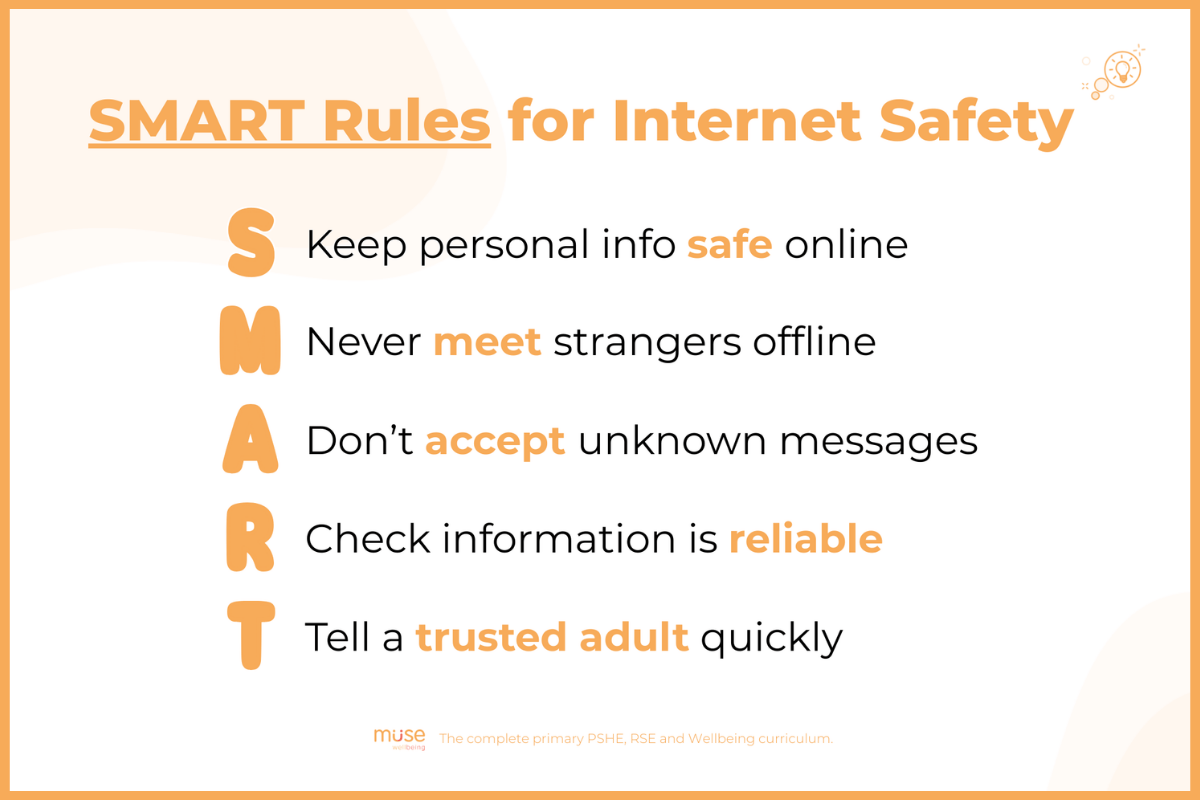
S – Safe
M – Meet
A – Accepting
R – Reliable
T – Tell
The SMART Internet Safety Rules are in line with the statutory Relationships and Health Education Guidance from the UK government which includes teaching young people about how to keep themselves safe while online. The full guidance can be found at the Department for Education.
Children should keep personal information safe. This includes names, addresses, passwords and school details. Protecting personal information reduces risk.
M – Meet
Children should never agree to meet someone they have only spoken to online. Online identities can be misleading. This rule supports physical safety.
A – Accepting
Children should not accept messages, images or files from people they do not know. Unknown content can be harmful or upsetting. Caution prevents exposure to risk.
R – Reliable
Not everything online is true. Pupils should learn to question information. Critical thinking builds digital resilience.
T – Tell
Children should tell a trusted adult if something online worries or upsets them. Early reporting allows adults to help. Open communication keeps children safe.
The SMART Internet Safety Rules are in line with the statutory Relationships and Health Education Guidance from the UK government which includes teaching young people about how to keep themselves safe while online. The full guidance can be found at the Department for Education.
Teaching Internet Safety SMART Rules in KS1 and KS2
When teaching Internet Safety SMART Rules, it's important that the material be suitable for the pupil’s age and progress appropriately through the years. Although the subject matter can remain the same, the level of detail will increase as the pupils grow in their digital experience.
The UK Council for Internet Safety has made the point that Online Safety needs to be embedded throughout the Curriculum in order to avoid being confined to one lesson per year. Their resources can be accessed through gov.uk guidance. Consistent reinforcement ensures that SMART internet safety rules become part of everyday thinking rather than a one-off reminder.
In Key Stage 1, the lessons are designed with a more simplistic, practical approach. In these lessons, children identify what constitutes personal data. Children practice recognizing who they trust to go to for help when something feels wrong online. Children also participate in role-playing scenarios where they demonstrate how to react when something feels wrong. You can explore this in more detail in our KS1 guide to internet safety in Year 1 and Year 2.
In Key Stage 2 pupils' learning becomes more reflective as well as more analytical. Pupils are able to explore their own "digital footprint". They will be able to critically evaluate a number of the chat options available in online gaming. Pupils will also be able to critically evaluate how social media can have an impact on wellbeing. The deeper level of critical evaluation that is associated with these topics enables pupils to develop safer ways to operate independently online.
The UK Council for Internet Safety has made the point that Online Safety needs to be embedded throughout the Curriculum in order to avoid being confined to one lesson per year. Their resources can be accessed through gov.uk guidance. Consistent reinforcement ensures that SMART internet safety rules become part of everyday thinking rather than a one-off reminder.
Importantly, internet safety should not create fear. The aim is to build confidence and responsibility. When children understand both opportunity and risk, they are better equipped to navigate online spaces safely.
Digital Citizenship VS Internet Safety
Internet safety and digital citizenship have some similarities, however, they are not one in the same. Schools can use this distinction as a planning tool. Internet safety is focused on staying safe when you go online. It is focused on stopping or preventing any harm that may occur while online. Internet safety includes being private, secure and using safe forms of communication.
Digital citizenship has a much broader focus than just safety. Digital citizenship encompasses our behavior when online. Digital citizenship includes things such as being respectful, empathetic, responsible with your sharing and understanding what digital rights are. You can explore this comparison further in our article on digital citizenship vs internet safety.
In simple terms, internet safety is about protection. Digital citizenship is about participation. Both are essential within a modern PSHE curriculum. The Education Endowment Foundation highlights that social and emotional learning improves both wellbeing and academic outcomes. Teaching respectful digital behaviour supports this aim. Their research summaries can be found at the Education Endowment Foundation.
When schools teach internet safety SMART rules within a wider digital citizenship framework, pupils develop both caution and character. This balanced approach supports long term wellbeing.
Internet Safety Lessons in Muse Wellbeing
The SMART internet safety rules are built into many of the Digital Citizenship lessons in the Muse Wellbeing curriculum; the lessons build upon each other from Year 1 through Year 6. Each year builds upon the basic safety rules of previous years, therefore the children have a strong foundation of what is expected of them when using the internet.
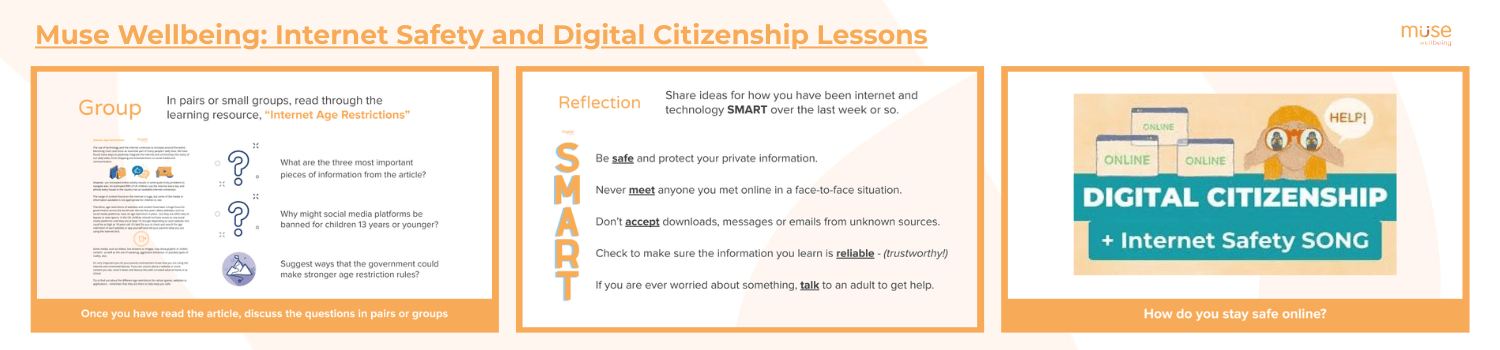
Lower Key Stage 2 children will learn who their trusted adults are and how to respond safely in different situations, whereas Upper Key Stage 2 children will look at real-life online examples, have discussions about digital responsibilities, and think critically about the way they consume media. The structure of our lessons ensures that the safety messages we teach are retained, and this is achieved through our 'spiral' learning process.
The Muse Wellbeing lessons are in line with the statutory requirements for Relationships and Health Education (as outlined by the Department for Education) and support the wellbeing aspects of the children's education; many children experience emotional wellbeing issues related to online experiences. The NHS provides helpful guidance for parents and schools on supporting children’s mental wellbeing in digital contexts at nhs.uk.
Internet safety SMART rules will be part of a larger PSHE curriculum that develops pupils' emotional wellbeing and provides them with the tools to form positive and respectful relationships and make well-informed decisions about how they live their lives. The way pupils behave online can never be taught as a separate subject; it is always linked to values, empathy and taking responsibility for one's own actions. When schools embed SMART internet safety rules into weekly PSHE sessions, this helps to build consistency. Pupils will hear the same terms used consistently throughout assemblies, class discussions and in all school policies. Consistency gives pupils the opportunity to feel confident.
Conclusion: Why Internet Safety SMART Rules Matter
SMART Rules of the Internet are used by teachers and parents as a common and memorable way to teach young people about staying safe while using the Internet. The SMART Rules help break down all the complicated ways you can be at risk online into simple guidelines that are easy for children to remember and follow.
This will allow teachers and parents to use a common vocabulary to talk to each other when teaching young children how to stay safe on-line. As an important part of Digital Citizenship in the UK's Primary Schools, the need to teach Internet Safety is becoming increasingly important. When well planned, SMART Internet Safety Rules give young children confidence and independence instead of fear.
At Muse Wellbeing, we believe online safety education should be calm, clear and consistent. Explore our full curriculum to see how internet safety SMART rules are embedded across all year groups and discover how your school can strengthen its digital provision today.

Better Wellbeing for all
school communities
school communities
Muse Wellbeing
Support
Subscribe for RSHE & Wellbeing Updates & Learning Resources
Receive essential information on RSHE and wellbeing for your school and community
Thank you!

Copyright © 2026 Muse | All Rights Reserved.
Ready to logout of Muse Wellbeing?
logout of Muse Wellbeing?Write your awesome label here.
Created with