PSHE Assessment Guide
Authored by the Muse Wellbeing Team
First Published on the 4th of April, 2026.
Lead Writer
David is a qualfied British teacher and the Muse Wellbeing director and lead curriculum developer. His main passions include education, surfing (badly) and travel.
Editor and Review
With over 15 years of experience teaching in primary schools in northern England, Charlotte has played a key role in shaping many lessons across the Muse Wellbeing curriculum.
Assessment in PSHE helps schools understand what pupils know, how their understanding is developing, and whether the curriculum is making a meaningful difference over time. Assessment should not turn PSHE into a test-heavy subject in primary schools. Rather, assessment in PSHE should help teachers recognise pupils’ growth, identify pupils’ needs, and plan the next steps with confidence. The PSHE Association’s guidance on assessment in PSHE education explains that effective assessment helps pupils and teachers reflect on what has been learned, increases motivation for future learning, and demonstrates impact.
In addition to giving schools a framework for assessing pupil development, PSHE also sits within the broader picture of child development and school life. The Department for Education describes PSHE as an important and necessary part of all pupils’ education, while also making clear that schools need flexibility to shape provision around the needs of their pupils. Finding the right balance between demonstrating impact and delivering a flexible programme is especially important for primary school staff. Schools looking to revisit the basics first may find our guide on what does PSHE stand for helpful for establishing context.
Should PSHE Be Assessed?
Yes, PSHE is a subject that should be assessed. However, assessment in PSHE should be developed differently from assessment in subjects such as maths, spelling, or science. In PSHE, assessment should help teachers understand where each pupil begins, track progress over time, and make sure teaching is helping pupils grow in knowledge, confidence, language, and the strategies they need to manage life well.
PSHE addresses issues that affect children on a daily basis, including relationships, health, safety, emotions, identity, and the wider world around them. Progress in many of these areas is unlikely to show itself through a traditional test. More often, it appears through discussion, reflection, decision-making, growing confidence, or the way a child applies learning to real-life situations. When a pupil can better describe a trusted adult, explain a safer choice, or reflect more thoughtfully on friendship issues, that is real development, whether or not it can be measured through a formal score.
Assessment in PSHE matters because it helps teachers answer simple but important questions. What did pupils understand before the lesson? What are they clearer on now? What still needs work? Used properly, it gives teaching a clearer direction and helps schools see whether the curriculum is genuinely supporting pupils over time.
What Type of Assessment Model Best Serves PSHE?
The best type of assessment model for PSHE is usually an ipsative model. With an ipsative model, a pupil’s progress is measured against their own earlier starting point rather than against other pupils. In most cases, this is the fairest and most sensible way to assess development in PSHE. The PSHE Association’s assessment guidance supports an ipsative model and includes examples of how baseline assessment, assessment during learning, and endpoint assessment can work together in practice.
Pupils enter the classroom with very different experiences, confidence levels, and prior knowledge. Some may already be able to discuss friendships, boundaries, or online safety with confidence. Others may still be learning how to identify emotions or ask for help. If schools use more fixed attainment measures, they may overlook the real progress a particular child is making. An ipsative model gives teachers a clearer view of development over time and keeps the focus on growth rather than comparison.
That is especially important in a subject like PSHE, where progress is often personal, gradual, and closely linked to each child’s age, experience, and level of confidence. A pupil may not be the strongest speaker in the class, but if they are thinking more clearly, using better language, or applying safer strategies than they were before, that progress should still be recognised.
What Does Good PSHE Assessment Look Like in Primary Schools?
Typical examples of good practice in PSHE assessment at primary level include simple, low-stress approaches that are built into everyday teaching. Commonly, this includes some form of baseline assessment before teaching begins so that staff can see what pupils know, think, or feel confident about before receiving instruction. This may take several forms, such as a brief discussion, confidence lines, scenario questions, sorting activities, or mind maps.
Throughout the learning, teachers collect evidence from conversations with pupils, observations during activities such as role play, responses given during class time, or short reflective tasks. At the end of the lesson or unit, pupils can then return to the original area of study so that teachers can more easily observe growth and development.
This works well because pupils develop PSHE-related skills in different ways. Pupils in Year 1 may improve their ability to identify feelings and seek help. Pupils in Year 3 may show a stronger understanding of respect and kindness. Pupils in Year 5 may become more able to apply safer thinking when engaging in online situations. Pupils in Year 6 may articulate their thoughts around peer pressure, consent, or emotional wellbeing with greater maturity. Many of these classroom-based examples become easier to picture once schools have a clearer sense of what a PSHE lesson looks like in practice.
PSHE Assessment Criteria: What Should Schools Measure?
Schools thinking about PSHE assessment criteria should usually take a broader view than simply recalling facts. While knowledge does matter, pupils do need to understand key vocabulary, core ideas, and essential messages relating to health, relationships, safety, and wellbeing. Effective assessment should also consider how well pupils are able to connect ideas, make links with their own experiences, and evaluate the impact of their decisions in real-world contexts.
The Education Endowment Foundation’s guidance on social and emotional learning in primary schools highlights the importance of explicitly teaching social and emotional skills, modelling those skills clearly, and giving pupils opportunities to practise and reflect on them over time. That broader view fits well with the goals of strong PSHE assessment in primary settings.
Many schools therefore find it useful to assess pupils’ understanding of key concepts, their ability to explain those concepts in age-appropriate language, their use of strategies linked to safety or wellbeing, and their confidence to seek help when needed. These kinds of assessment criteria should remain proportionate. PSHE is not about requiring pupils to disclose private information, nor is it about judging a child’s personal feelings. It is about determining whether teaching has helped pupils develop understanding, language, and preparedness for life.
Using Wellbeing Questionnaires as Part of the Bigger Picture
Alongside assessment carried out during everyday teaching, some schools also use wellbeing questionnaires to build a broader picture over time. These can be especially helpful when schools want to identify patterns, notice wider trends, and think carefully about the support pupils may need.
Muse Wellbeing includes two wellbeing questionnaires as part of its curriculum and recommends using them either termly or annually, ideally when pupils enter a new year group or at the start of the academic year. Muse also makes clear that no formal assessment should replace a teacher’s continued understanding of the pupils in their care, and that results from the questionnaires should be used to guide action for individual pupils, groups, or whole classes when necessary.
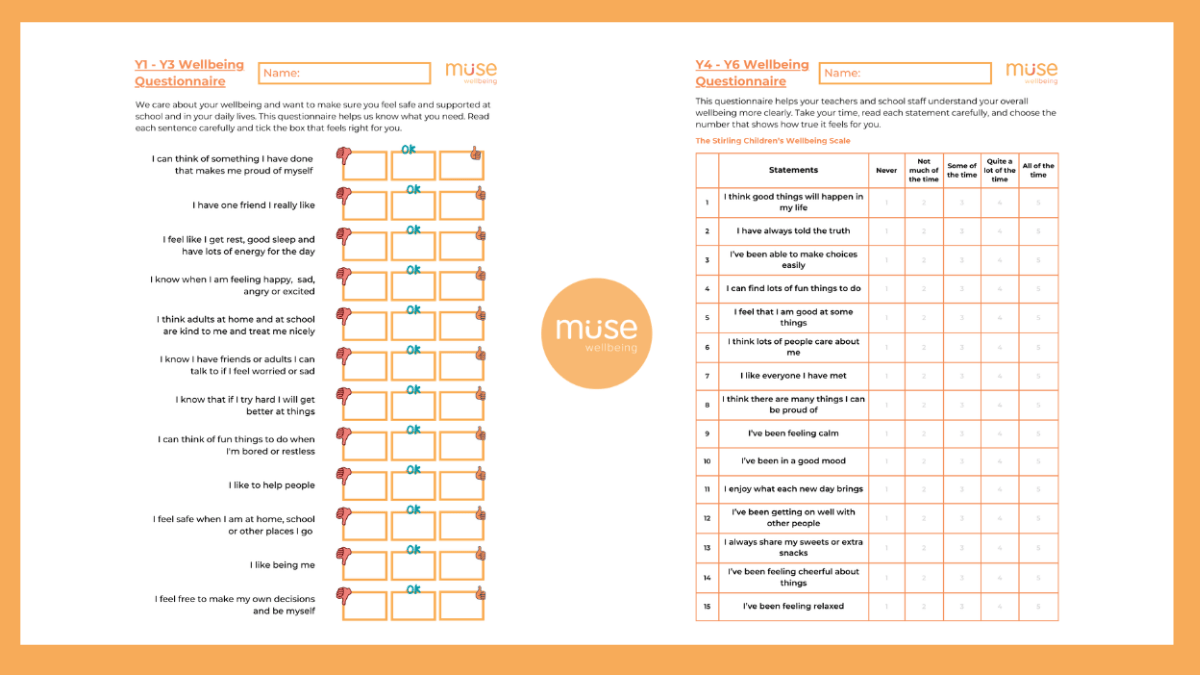
In Years 4 to 6, Muse Wellbeing uses an adapted version of the Stirling Children’s Wellbeing Scale. The attached guidance describes this as a research-backed scale designed to assess the wellbeing of children aged 8 to 15, with items grouped around positive emotional state, positive outlook, and social desirability. Muse also recommends saving this data over time so that staff can monitor patterns, track progress, and respond more effectively to emerging concerns.
If used thoughtfully, tools such as wellbeing questionnaires can make a valuable contribution to pastoral awareness and school-wide decision-making. However, they should be used alongside teacher judgement, not instead of it.
How to Record and Report PSHE Assessment Without Extra Work
One common concern among schools is workload. An effective PSHE assessment process should not create unnecessary additional work. In general, a light-touch approach tends to work best for most schools. Teachers may document brief comments linked to key objectives, save a small number of baseline and endpoint examples, collect useful observations, and outline next steps for future teaching. In many cases, this is enough to demonstrate pupil growth and support curriculum review.
Reporting should also reflect the nature of the subject. Rather than assigning artificial grades, schools may report on developing understanding, participation, reflection, and how pupils are using previously learned content. Reporting in this way gives parents and school leaders a clearer picture of how pupils are developing through PSHE.
The Department for Education’s PSHE guidance also reinforces the idea that schools should equip pupils with a sound understanding of risk and the knowledge and skills needed to make safe and informed decisions. This is one reason why practical, proportionate assessment matters so much in primary schools.
A Pragmatic Approach to PSHE Assessments
Assessment in PSHE is most effective when it is purposeful, manageable, and connected to the wider goals of the subject. Its purpose is to help teachers recognise pupil progress, understand pupil needs, and strengthen provision over time. Most primary schools will achieve this through baseline activities, classroom discussion, observation, reflection, and light-touch recording rather than through formal grading.
When lesson sequences are well planned, it becomes much easier for teachers to see what pupils are developing towards. That is one reason why having a clear curriculum matters so much. Assessment in PSHE is rarely about a single event. More often, it is about building a picture of pupil growth over time while noticing the changes that emerge.
When schools are reviewing provision more broadly, it can also be helpful to look at a complete PSHE curriculum in KS2 or explore the wider Muse Wellbeing curriculum. A clear curriculum structure makes assessment easier because staff can see what pupils are building towards across the year, and across the school as a whole.

Better Wellbeing for all
school communities
school communities
Muse Wellbeing
Support
Subscribe for RSHE & Wellbeing Updates & Learning Resources
Receive essential information on RSHE and wellbeing for your school and community
Thank you!

Copyright © 2026 Muse | All Rights Reserved.
Ready to logout of Muse Wellbeing?
logout of Muse Wellbeing?Write your awesome label here.
Created with